



Momentum is a powerful force and once it starts, it’s incredibly hard to stop. Think of a snowball turning into an avalanche. A social media trend going viral. Steph Curry hitting his first three… then another… and another… now he can’t miss. When momentum is on your side, the wins come easier and success can start to feel inevitable.
The thing about momentum is it doesn’t start at full speed; it needs a catalyst. Momentum builds quietly, with small wins and a string of good decisions that seem insignificant at the time. You won’t feel it working at first and that’s what makes it difficult to trust because there’s no feedback loop telling you that you’re on the right track.
But that’s the point, real momentum is built long before it’s felt. That means doing the right things over and over and over again. Trusting the process long before you see any proof that it’s working. We see momentum in sports, culture, and life, yet we rarely think to apply it intentionally to our finances. But what if you did? What if you could build so much financial momentum that it would take an immense force to knock you off course?
Here are some ways to do so.
Investing Early and Often
Investing early and often is one of the most important things you can do to build financial momentum. And as they say, a picture is worth a thousand words.
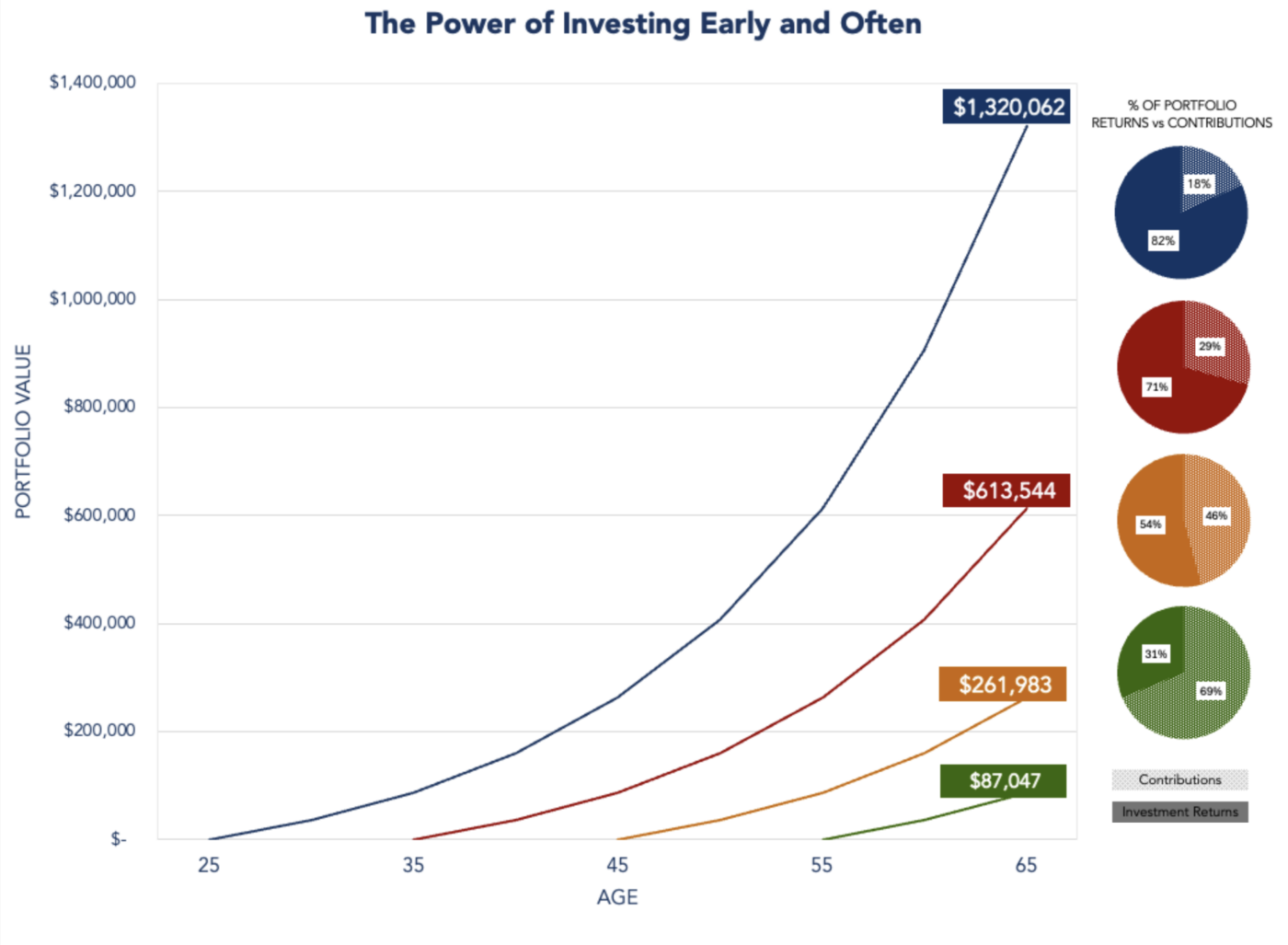
Our brains are wired to think about the future in a linear fashion, but investing is about capturing exponential growth. Progress appears negligible at first, but as the years go by it becomes impossible to ignore. And as you can see in the chart above, the difference between starting 10 years later is staggering.
So at what point do you build real financial momentum?
Look closely at the pie charts. For the investor who started at 55 years old, 69% of their portfolio comes from their own contributions and only 31% from investment growth. For the investor who started at 35, it’s flipped. 71% comes from investment growth, and only 29% from contributions. That is a huge shift. It’s also a 20 year age difference, not to gloss over that detail lightly.
The point is, the sooner you start, the earlier your portfolio begins doing the heavy lifting for you. And once your investment returns outpace what you’re able to save, you’ve built real financial momentum.
Remove the Friction
To sustain and accelerate momentum, you’ll want a system that makes good decision making easy. To do so, it’s best if you remove all the points of friction that can quietly drain your time, attention, and motivation which ultimately slow you down.
Consolidate Your Accounts: You might have a few accounts at different banks, multiple credit cards, investment accounts at different custodians, an old 401(k) here and there. Consolidating accounts where possible, will simplify your life and make taking action more efficient. The less there is to manage, the easier it is to stay on top of. Think of your financial life like a company, you want to be making strategic executive decisions, instead of being trapped in the details reconciling too many accounts.
Automate Good Decisions: Make a good decision once, then remove yourself from having to make it again. Schedule automatic transfers to your savings, brokerage, and 529 accounts with each paycheck. Set up automatic 401(k) contribution increases, rebalancing, dividend reinvestments, and extra principal payments on debt. Set your credit cards to auto pay. The point of automation is you’d have to make a conscious effort to opt out of a good decision.
Have a Consistent Strategy: For decisions that you can’t automate, you want to have a consistent process, especially as your financial life becomes more complex. Portfolio decisions, managing stock compensation, investing your bonuses, handling raises, tax planning, and charitable gifting all become easier when you already have a framework in place and have made the decision before it happens. Without a process, it becomes much easier to make reactive or emotional decisions.
Build in Buffers: One of the biggest sources of financial friction is constantly operating with no margin for error. An emergency fund, extra cash in your checking account, or giving yourself more time before deadlines can prevent small problems from becoming stressful emergencies.
Of course this isn’t an all inclusive list, just a few of the most common examples we see. So think of the financial points of friction in your own life and ask yourself is there anything that you can take action on today?
Keep the Momentum Rolling
One of the biggest misconceptions about building wealth is that you need to nail every decision. You don’t. You just need to make more good decisions than bad ones (and avoid the disastrous ones). People lose momentum because life gets busy, financial decisions pile up, and the to-do list becomes so long that it eventually leads to inaction. They didn’t have time to intentionally make space to think about the future.
This is where a financial planner and investment advisor can help you build a system that actually works. Someone to help you organize the moving pieces, reduce the unnecessary friction, and keep the momentum rolling.
Because once momentum is on your side, it becomes incredibly difficult to stop.

Ryan Moriwake, CFP®, CPA – Investment Advisor
Ryan was born and raised in Honolulu, Hawai’i, and now calls Seattle home. A graduate of Seattle University with degrees in Accounting and Finance, he’s passionate about helping clients make confident, informed financial decisions. Outside of work, Ryan enjoys traveling, golfing, grilling, and cheering on his favorite teams.